
Thursday, February 5, 2009


Tuesday, January 20, 2009

EXTERIOR MODS:
Complete M3 GTR Bodykit ( all carbon fibre ! ) :- Front Bumper, Front Wings with Vents, Bonnet with Vents, Side Skirts, Rear Arches, Rear Bumper with Aero wings, Do-Luck Type 1 Rear wing – Adjustable with CNC uprights, ATL Dry Break Fuel Filler – dual port, Eibach Wheel Spacers, Bilstein Adjustable Coilover suspension, AP Racing 6 pot brake callipers, discs and pads, AP Racing brake lines, Castrol Brake Fluid, Custom Need for Speed Most Wanted graphics

INTERIOR MODS:
AAR Paris Dakar Racing Seats – FIA Approved, TeamTech Racing Harnesses – SFI Approved, Sumo Power Harness Eye bolts and brackets, Momo Racing Steering Wheel, Momo Steering Wheel Boss Kit, Hauser Bolt in 4 point roll cage – rear section only, powder coated silver, Aluminium Panelling of back seat area, ( rear seats removed ), Custom Need for Speed Most Wanted graphics Paintwork by : Crash Corrections


Friday, December 12, 2008

2006 Chevrolet Corvette Z06 vs. 2006 Ferrari F430, 2007 Porsche 911 Turbo
The Sports-Car World Cup: Italy takes on Germany and the U.S. on the highways (and byways) of Germany.


The arrival of a new Porsche 911 Turbo is an event that's as significant and riveting for car enthusiasts as the winner of American Idol seems to be for the majority of adult Americans. The Turbo is important because it has resided at the pinnacle of the 911 line since it first went on sale in the U.S. in 1976 and has thus been a perennial contender for the title of best darned sports car on the planet.
The 2007 Turbo is a development of the Type 997 version of the 911, which was introduced two years ago in Carrera and Carrera S forms. Externally, there's little chance of confusing it with its lesser brethren, thanks to a huge biplane rear wing, wider rear wheel arches, stunning 19-inch wheels, and more scoops than a Baskin-Robbins shop. Inside, leather swathes seemingly every surface, but otherwise the car is differentiated from cheaper 911s only by Turbo graphics on the sills and gauges and a unique shifter.
Of course, the real reason the Turbo's base price of $123,695 is about 40 grand more than that of a Carrera S is because it's a showcase for Porsche's most high-tech performance pieces. The horizontally opposed 3.6-liter engine isn't actually the same one found in the Carrera but is a development of the dry-sump unit fitted in the previous-generation Turbo and GT3 and the new GT3. It has a bigger bore and shorter stroke than the Carrera engine and also uses a separate crankcase and cylinder blocks. (The Carrera engine is cast with the crankcase and cylinder blocks as one unit.)
In common with the outgoing turbo engine, VarioCam Plus variable camshaft timing is used to alter valve lift and timing, and the exhaust valves are sodium filled to aid cooling. Unlike in the previous engine, the twin turbochargers feature variable vanes. At low rpm, the vanes close to speed up the exhaust gases and reduce turbo lag, but they open at higher speeds for maximum power. The turbo bearing cases are now water cooled. The upshot is an output of 480 horsepower and maximum torque of 457 pound-feet. (With the optional Sport Chrono package, there's an overboost function that increases turbo pressure by about 2.9 psi, giving maximum torque of 502 pound-feet.)
 Like all 911 Turbos going back to the 1995 993, this one has all-wheel drive. The outgoing model used a center viscous coupling, but the new car features an electromagnetically controlled clutch pack at the center differential. This is a major component of the Porsche Traction Management system. Reading data from the onboard sensors, PTM shunts torque between the front and rear axles to reduce understeer or oversteer, to preload the clutch for maximum traction at launch, or to minimize wheelspin on slippery surfaces. The Turbo also has the Porsche Stability Management (PSM) and Porsche Active Suspension Management (PASM) stability-control and electronic-damping systems. A rear-locking differential is optional (our car had it) on models fitted with the six-speed manual transmission, but not on cars that have the five-speed Tiptronic manumatic.
Taking its cue from the Carrera GT, the Turbo has six-piston front-brake calipers, which here act on 13.8-inch-diameter vented discs. There's the option of even larger 15.0-inch discs with the $8840 ceramic composite option. Thanks partly to aluminum doors, the new Turbo weighs about the same as the outgoing car, but it's still the porker of this group at 3514 pounds.
We were expecting the '07 Turbo to be special, but just how good is it? To find out, we traveled to Germany and brought along a Ferrari F430 and Chevrolet Corvette Z06 for comparison. Those both provide similar amounts of horsepower and performance for wildly differing amounts of money — a base of $65,690 for the 505-hp Corvette and a whopping $174,535 for the 483-hp F430.
 For various reasons, Ferrari couldn't provide us with a car because the company was at full stretch with the launch of the 599GTB, but we suspect it was gun-shy about putting its car up against the Corvette. However, Gerrit Schumann, an Internet entrepreneur we know in Germany, generously lent us his car for a couple of days. He wasn't too keen on our running standing starts, having fried a clutch when using the launch-control function, so we took the standing-start acceleration and braking results from our "Lords of Envy" comparison [C/D, August 2005]. In Europe, we stormed the German autobahns and back roads and tested at the magnificent Papenburg facility in northern Germany, which features a 7.6-mile-long high-speed oval and a replica of the short course at Hockenheim, home of the German Grand Prix.
Friday, November 14, 2008
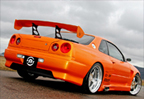
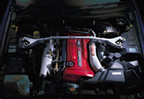
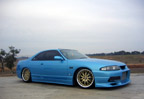
Nissan Skyline .6te.net is designed to provide you with the specifications for the latest models of the most popular Japanese sports car the Nissan Skyline. The handling and speed of the skyline has caused many motor magazines compare it to cars like the Porsche 911, and Ferrari, but the cost of the Nissan is significantly less.
The legendry nissan skyline RB26DETT is arguably the most tunable engine on the planet 1000hp GTR's are not uncommon in Japan and the strength of these engines is amazing. Many Manufactures have produced bolt on parts to boost the power output way beyond stock. Handling features way ahead of their time like the ATTESSA four wheel drive system and the HICAS four wheel steering system had the nissan skyline ahead of the competition.
2008 BMW M3 vs. 2009 Nissan GT-R vs. 2008 Porsche 911 Turbo


When the Spanish arrived in the New World some 500 years ago in their enormous wooden sailing ships, it is said the indigenous people standing on the shore literally did not see the great vessels on the horizon because they simply weren’t a part of their world—their visual reality. It took a few days for the wondrous ships to register, to become part of the natives’ visible existence. The story reminds us that reality is limited to what the human senses can perceive and what our neurons can process.
Like those indigenous Americans trying to grasp the new, it took us a several days to get a handle on the 2009 Nissan GT-R, to see it for what it is. We’re still in wonderment over the reality of a 3900-pound coupe that seems to break Newton’s laws. Can this be real—Ferrari performance for $70,000? Is the GT-R a good thing, or is it evil, some kind of postmodern god?
We first came in contact with a Nissan Skyline GTR in 1991. At the time, the quickest car on the road was a Ferrari F40—0 to 60 mph in 4.2 seconds. The car, a gray-market Japanese-spec Skyline GTR tuned to deliver 350 horsepower (up from the standard 276 horsepower), would quickly rearrange the furniture in our heads. Powered by a 2.6-liter, twin-turbo inline-six, it matched the F40’s 0-to-60 time.
We’d have to wait 17 years before another GT-R arrived here. It ripped from 0 to 60 in 3.3 seconds [May 2008]. That equaled the time of the F40’s heir, the ferocious Ferrari Enzo. As to Ferraris currently being built, the GT-R is as quick to 60 mph as the 611-hp 599GTB Fiorano [June 2007] that sells for $280,295.
In ’91 we struggled with how the Skyline GTR would fit into our automotive landscape. But since it was not sold in this country, we spotted something shiny and our interest drifted off. Now it is officially here, and we’re struggling to determine where it fits in, what it competes with, and why the name “Skyline” was dropped but GTR given a hyphen.
When gathering opponents for this comparison, we fell back on a lesson we learned a few years ago: When your automotive bearings are shaken (as the GT-R has the power to do), invite a Porsche 911 to recalibrate. On paper, the closest 911 model to the GT-R, in terms of philosophy, is the 480-hp, all-wheel-drive Turbo, which is why it’s here. Yes, a Porsche Turbo costs nearly twice the asking price of a GT-R, it’s not the staff’s favorite 911 (we’re partial to the naturally aspirated models), and it didn’t win its last comparison-test outing. But the 911 Turbo is indeed the car Nissan put on its performance pedestal, the car to get. So if any car can help us make sense of the GT-R’s place in the world, it’s the 911 Turbo.
To bookend the GT-R, we decided to add a BMW M3 coupe to the mix. Unlike the GT-R and the Turbo, the naturally aspirated M3 lacks turbochargers, and should a Chubby Checker twist competition break out, it would find itself seriously outgunned. Compared with the 505 pound-feet of torque spooled into the 911 Turbo and the 430 pound-feet found in the GT-R, the M3 has a seemingly minuscule 295 pound-feet. The M3 is out of its league in horsepower, too, but it makes up some of this handicap by weighing several hundred pounds less than its brethren. The M3 also has a price advantage: Our test car rang up at $63,600, the Nissan commanded $70,475, and the 911 Turbo dwarfed them both with a $127,060 base price. Throw in the M3’s two comparison-test wins against impressive opponents—Audi RS 4, Lexus IS F, Mercedes-Benz C63 AMG—and a solid case can be made for this middleweight’s claim to a shot against the two heavyweights.
At this point you’re expecting the obligatory paragraph introducing the ubiquitous comparo star, the Chevrolet Corvette Z06, especially if your name is Larry Webster. But, alas, the Z06 lacks back seats, and it was beaten by the 911 Turbo [“The Sports Car World Cup,” September 2006]. Yes, we might have included it anyway, but this time around, we’re keeping the competition to performance cars with four seats and a modicum of civility and practicality.
And consider this, Corvette dudes: Maybe there is a Z06 in the test—it’s just too awesome to see. That paragraph introducing it could be hiding here somewhere, maybe there’s really a Z06 in every photograph. You just can’t see it now. It might appear. Wait a few days.
Friday, November 7, 2008
Gallardo
Superleggera


A special version of the Gallardo, dubbed the Superleggera, was launched at the 2007 Geneva Auto Show supposedly in preparation for the next Ferrari 430 Scuderia. The Superleggera is lighter than the base Gallardo by around 70 kg (154 lb) - down to approximately 1,360 kg (3,000 lb) - thanks to the use of carbon fibre panels for the rear diffuser, undertray, the rearview-mirror housings, the interior door panels, the central tunnel, and the engine cover. Even the wheel nuts are made of titanium instead of steel to save even more unsprung weight at each corner of the car. According to the original Press Release issued by the factory the superleggera was available in four colors only : Midas Yellow, Borealis Orange, Telesto Gray and Noctis Black, however at least one white Superleggera has been built.
The intake, exhaust and ECU have been upgraded to release an extra 10 hp (7.5 kW) for a total of 530 hp (395 kW). The lightening and extra power result in a 0-100 km/h time of 3.8 seconds, 0.1 seconds faster than the base Gallardo. The 6-speed e-gear transmission, usually a US$ 10,000 option, now comes as a standard. The full price for a Superleggera with everything on it runs for over $200,000. The use of the 'Superleggera' brand was effectuated in agreement with Zeta Europe BV, which acquired the trademark from Carrozzeri
Lamborghini Gallardo
LP560-4


Wild Blue Yonder
Tonka Meets Lambo


Turning heads is a regular occurrence f or th is '03 Hummer H2 lifted to the clouds, showered in bright paint, and expressing enough attit ude for the wildest of SUVs. This H2, however, seems to have an identity crisis. Built rock solid with almost 20 inches of extra height under its frame, opening the doors is an admirable task, but when the doors go up instead of out, you have to think: Is this a Tonka truck or a mixed-up Lamborghini luxury hauler? Whatever the case may be, when Manny de Encio arrives and opens the doors, people just lose their minds.
We witnessed it first-hand, as we drove to our ultra-secret photo location for the cover shoot and saw people literally lose the ability to operate their automobiles. Pointing, gawking, and slowing down to admire the Hummer are everyday situations for Manny -- even if it is just a trip to the grocery store. It's no wonder, when he told us his plans for the H2, we were very interested in the blue one.
Manny is no stranger to the Hummer H2. He is responsible for a majority of the highest, sickest, and cleanest Hummers roaming the West Coast. His plan for this project was to build a higher, stronger, and faster Hummer than any of his previous builds. Beginning with a black '03 H2, the entire suspension was removed at his shop,
CTL Motorsports in Westminster, California. In place of the stock hardware now resides a complete 14-inch Bulletproof Suspension kit with dual Fox Racing 2.0 shocks with reservoirs and billet clamps. Each component was either chrome-plated by Anaheim Plating or painted to match the exterior. To raise the H2 high enough to accommodate the wheels Manny envisioned, a 3-inch body kit were installed. Now, entry and egress was a real challenge, and to make things even more difficult, a new set of Interco 49-inch-tall tires were mounted on custom Weld 17x14-inch Mountain Crusher wheels and bolted to the H2. Stopping the huge monster is not easy, and that responsibility was placed in the hands of Power Slot rotors and Hawk brake pads. Now that he had the H2 at the height he wanted, Manny moved to the interior for improved looks and sounds.
Inside the H2, a host of audio and video products makes the trips to shows, the river, or work a joy. Eiger Vision supplied the DVD player, 7-inch motorized screen in the dash, and four 7-inch monitors in each headrest. Plenty of decibels can be heard coming from the H2 thanks to Crossfire Audio, which supplied the two 15-inch subs in the rear and two 8-inch subs in the front doors. Powering the speakers are a total of six Crossfire amps, and just in case the low frequencies are too much, the H2 is also equipped with four sets of Crossfire components providing plenty of highs and mids. The system was built and installed by the crew at CTL, and is wired with audio cables from EFX by Scosche. An Optima Yellow Top battery handles the starting power, and a quick connect 110V power supply is wired in for show demonstrations. Manny's stock H2 seats were upholstered by the talented guys at 714 Motorsports, who added baby ostrich leather, giving the H2 a luxurious look and feel.
Subscribe to:
Posts (Atom)


